Your web browser does not support JavaScript or you have disabled it. The menus on this site will not work without JavaScript.


Free Weekly eNewsletter

401k Plan Loans - An Overview

    
Allowing loans within a 401k plan is allowed by law, but an employer is not required to do so. Many small business just can't afford the high cost of adding this feature to their plan. Even so, loans are a feature of most 401k plans. If offered, an employer must adhere to some very strict and detailed guidelines on making and administering them.

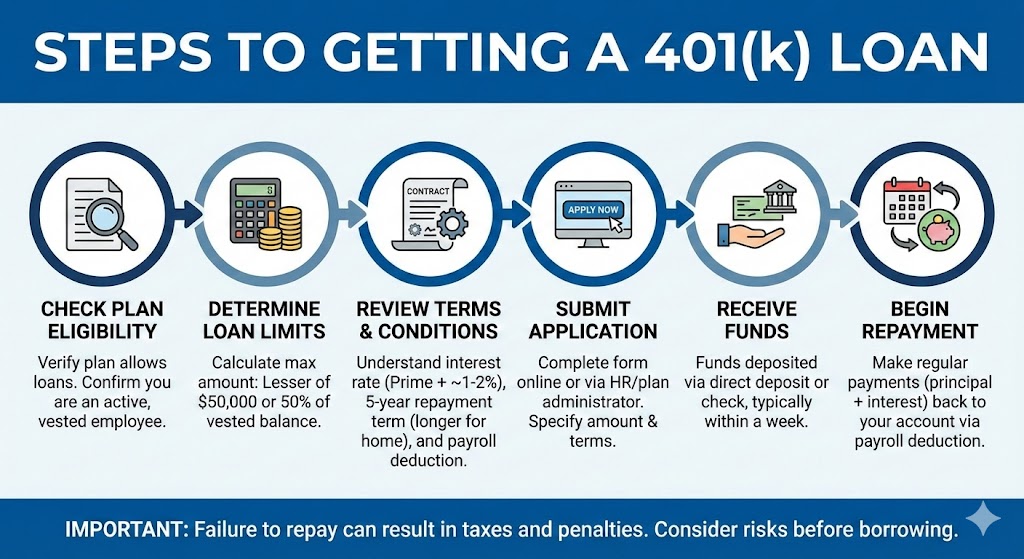
The statutes governing plan loans place no specific restrictions on what the need or use will be for loans, except that the loans must be reasonably available to all participants. But an employer can restrict the reasons for loans. Many only allow them for the following reasons: (1) to pay education expenses for yourself, spouse, or child; (2) to prevent eviction from your home; (3) to pay un-reimbursed medical expenses; or (4) to buy a first-time residence. The loan must be paid back over five years, although this can be extended for a home purchase.

If a participant has had no other plan loan in the 12 month period ending on the day before you apply for a loan, they are usually allowed to borrow up to 50% of their vested account balance to a maximum of $50,000. If the participant had another plan loan in the last 12 month period, they will be limited to 50% of their vested account balance, or $50,000, minus the outstanding loan balance in the preceding 12-month period, whichever is less.

Because of the cost, many plans will also set a minimum amount (often $1,000) and restrict the number of loans any participant may have outstanding at any one time.

Loan payments are generally be deducted from payroll checks and, if the participant is married, they may need their spouse to consent to the loan.

While interest rates vary by plan, the rate most often used is what is termed the "prime rate" plus one percent. The current "prime rate" can be found in the business section of your local newspaper or the Wall Street Journal.

Funds obtains from a loan are not subject to income tax or the 10% early withdrawal penalty (unless the loan defaults). If the participant should terminate employment, often any unpaid loan will be distributed to them as income. The amount will then be subject to income tax and may also be subject to 10% withdrawal penalty. A loan can't be rolled over to an IRA.

Just because you can obtain a loan from your plan doesn't mean it is always the best idea. So before sticking your hand in the cookie jar, you should consider the "pros and cons," some of which may surprise you. And remember, the purpose of a 401k plan is to fund your retirement, so don't shortchange your golden years by treating it as a checking account.

The Pros:

  1. It's convenient. There is no credit check or long credit application form. Some plans only require you to make a phone call, while others require a short loan form.
  2. There is a low interest rate. You pay the rate set by the plan, usually one or two percentage points above the prime rate.
  3. There usually are no restrictions. Most plans allow you to borrow for any reason.
  4. You are paying the interest to yourself, not to the bank or credit card company.
  5. The interest is tax-sheltered. You don't have to pay taxes on the interest until retirement, when you take money out of the plan.
  6. You choose where the money comes from. The advantage of being able to choose which investment option you will sell in order to obtain the funds for your loan is that you can leave untouched those investments with the best performance.

The Cons:

  1. There are "opportunity" costs. According to the U.S. General Accounting Office, the interest rate paid on a plan loan is often less than the rate the plan funds would have otherwise earned.
  2. Smaller contributions. Because you now have a loan payment, you may be tempted to reduce the amount you are contributing to the plan and thus reduce your long-term retirement account balance.
  3. Loan defaults can be harmful to your financial health. If you quit working or change employers, the loan must be paid back right away. It's not uncommon for plans to require full repayment of a loan within 60 days of termination of employment. If you can't repay the loan, it is considered defaulted, and you will be taxed on the outstanding balance, including an early withdrawal penalty if you are not at least age 59 ½.
  4. There may be fees involved.
  5. Interest on the loan is not tax deductible, even if you borrow to purchase your primary home.
  6. You have no flexibility in changing the payment terms of your loan.

When You Probably Shouldn't Borrow From Your Plan

It is probably not wise to take out a 401k plan loan when:

  1. You are planning to leave your job within the next couple of years.
  2. There is a chance you will lose your job due to a company restructuring.
  3. You are nearing retirement.
  4. You can obtain the funds from other sources.
  5. You can't continue to make regular contributions to your plan.
  6. You can't pay off the loan right away if you are laid off or change jobs.
  7. You need the loan to meet everyday living expenses.
  8. You want the money to purchase some luxury item or pay for a vacation.

Commonly Asked Questions:

What are some of the most common reasons people take out a plan loan?

The most common reasons of a plan loan are:

  1. To pay college tuition.
  2. Uninsured medical expenses.
  3. The purchase of a primary residence.
  4. Payments necessary to prevent being evicted or defaulting on a mortgage.

If I want to borrow for a down payment on the purchase of my primary residence, do I have to pay the loan back in five years like a normal 401k loan?

No, most plans allow longer pay back terms when the loan is going to be used to purchase a primary residence. Ten to fifteen years is common.

How long do I have to pay off my loan if I quit my job?

Typically, if you quit working or change employers, it is not uncommon for plans to require full repayment of a loan within 60 days of termination of employment.

Will a 401k loan appear on my credit report?

Loans from your 401k are not reported to the credit-reporting agencies, but if you are applying for a mortgage, lenders will ask you if you have such loans and they will count the loan as debt.

If I default on my loan, will the default be reported to the credit-reporting agencies?

If you default on a 401k loan, the default will not be reported to the credit-reporting agencies and it will not negatively impact your credit rating.

If I can't afford to keep making the payments on my loan, can I stop them?

Once the loan has been made, your payments will be deducted from your pay each month and you generally can't stop this process.

If I default on my loan, how will I know the amount I must report as income on my federal tax return?

You will receive a 1099 from the plan which will show you the exact amount to report. This amount will also be reported to the IRS.

I still have a 401k account at a former employer. Can I get a loan from this old 401k?

Plans are not require to let former employee take plan loans and few allow them to do so.

Where can I learn more about how my specific plan handles 401k loans?

Talk to your plan administrator or ask them for a copy of your plans Summary Plan Description (also known as an SPD). The SPD will spell out exact how and why you can obtain a loan from your 401k.

For more background and information on 401k plan loans, check out these resources:

Don't Tap Your 401k to Pay Off Debt - Summary: If you take money out of your 401k to pay off your debts, you may regret it later. Taking out a loan or an early withdrawal will reduce your eventual retirement account and may force you to work longer.

The Two Biggest Traps Behind 401k Loans and How to Avoid Them - Summary: Most financial experts will tell you that tapping a 401k for a loan should always be viewed as a last resort. But, for many they can still sound pretty attractive. If you're thinking about taking one out, you need to understand the down side of 401k loans and, in particular, two areas that are especially hazardous.

Borrowing from Yourself: The Determinants of 401k Loans - Summary: This paper explores the determinants of people's decisions to take 401k loans. It argues that 401k plans do not simply represent retirement saving, but they provide a means of saving for precautionary purposes. It model factors that rationally would induce people to borrow from their pension plans, and explains why people do not often use 401k loans to replace their more expensive credit card debt.

Eight Reasons to Never Borrow From Your 401k - Summary: Pundits claim that your 401k balance is a less expensive way to borrow money because the interest rate charged is generally lower than the rates on a commercial loan. They also cite the fact that when you repay the loan, you are paying yourself back with interest, instead of paying a bank. Despite these claims, borrowing from your 401k goes against almost every time-tested principal of long-term investing. There are eight major reasons why this type of thinking is short sighted.

Loans Vs. Hardship Withdrawals: Penalties and Taxes - Summary: Despite a more stable economy, many Americans are still finding it hard to make ends meet and find that they are having to tap one of their most important and final saving vehicles – their company sponsored 401k plan.

Retirement Loans - Summary: Retirement plan loans are generally easy to obtain. And there are not a lot of expenses attributed to them. And if your credit is less than golden, you might find it easier and cheaper to borrow from your retirement plan than from a commercial lender. But, there are pros and cons.

Should You Borrow From Your 401(k) or 403(b)? - Summary: These days, many workers with 401k's can borrow from their plans. And a growing portion of 403(b) plan participants can too. If you've been diligently socking away a portion of your salary over the past few years (and you've had a match to boot), chances are that puts a lot of cash at your fingertips. It certainly doesn't make sense to use this money for luxuries like a backyard swimming pool or a new car. But does it make sense to tap your 401k or 403(b) to pay off a loan?


Press Center | Glossary | Privacy Policy | Terms of Use | Contact Us
by 401khelpcenter.com, LLC